


When my son was small he would constantly beg my husband “tell me a story dada”…and my husband would dutifully spin an adventure involving muscular woodland creatures and supernaturally-powered little boys against villains or foes of all kinds. At the end of every story my son would always cry “again!” And my husband would spin another and another and another until our son slept or ceased or moved on.
I also began a fascination stories—writing them—when I was young. My earliest written stories about secret keepers and precocious children are in a journal I got when I was eight, which began an almost obsessive need to scribble everything random down, seeking to order its parts.
Why do we love stories so? There are entire areas of study based on this very question, from the ontological to the psychological to sheer entertainment.
Tell me about your love/need/connection to stories in the comments.
“Stories are medicine. I have been taken with stories since I heard my first. They have such power; they do not require that we do, be, act, anything -- we need only listen.” —Clarissa Pinkola Estés, Women Who Run With the Wolves
For the maker and the listener/reader/watcher, stories can feel resonant, meaningful, cathartic. They set structures that organize, crystalize, and even transform many realities that seem to make no sense (war, corruption, abuse…). We writers (and other kinds of storytellers) know the joy that manifests in the meaning-making phase, whether that’s writing a good mystery yarn, curating life into memoir, or simply enjoying the bliss of forming a flowing sentence.
However, there is the making of the story…and then there is how we get those stories into the hands of readers. This is the part of writing that most writers loathe—where sanitized sounding words come into play: platform, promotion, marketing.
(There’s a whole other discussion to be had about “writing and rewriting narratives” that’s apt and timely, too, but I am not coherent enough to talk about that today. I defer to others instead, like ProPublica, Heather Cox Richardson and comedian/social commentator Josh Johnson).
I am thinking about the disseminating of stories more than ever in light of what just did—or didn’t—happen to TikTok, which went dark for around 12 hours in what now feels more like a stunt to make rich people richer than anything meant to protect U.S. security. That, coupled with people’s desire to leave Facebook and other Meta products (Instagram/Threads) for the billionaire founders’ support of the new regime. TikTok was responsible for perhaps the most mind-blowingly “viral” way of spreading books ever, BookTok—spurring millions of book sales, launching indie authors and making sub-genres like Romantasy blow up.
“You’re never going to kill storytelling, because it’s built in the human plan. We come with it.”― Margaret Atwood
Agents and publishers have been demanding more and more that authors have a “platform” over the past two decades—a following, a waiting hungry audience just like this. (I sold my book Make a Scene in 2003, at a time when that word didn’t yet relate to books, and when I didn’t really have one.) We seem to be caught in a cycle now where we need these media platforms to sell our work or do our work, even if we no longer want to be there. It’s the capitalist ouroboros.
Meanwhile. Most writers just want to write. Every time I sit down to promote my own novels, I feel like taking a nap. We’re all inundated with information as it is. My own TBR stack of books both existing and forthcoming (physical, e-book and audiobook) are so big and growing every day I could let that overwhelm me if I wanted to. If I stopped working today and did nothing but read for the rest of my life (which honestly, sounds amazing), I couldn’t even make a dent in what I want to read.
This post, if you haven’t figured it out, isn’t giving you answers to how to sell more books. Connecting genuinely is the only way that feels organic to me, but I know it doesn’t sell enough books. Yet I think it’s equally as important.
In fact…this was the longest winded and least enthusiastic sales pitch ever. It was my way of saying that I’ll be honest…self-promotion is PAINFUL to me. It feels aggressive and distracting, and I wish that instead my books just magically landed in your homes and e-book readers and the like through magic wish powers instead!
BUT I’d say my novel Fallout is timely and might pluck that chord of people—especially women but certainly not relegated to—who feel powerless, who feel at the mercy of abusively powerful men, of industries that are part of the problem that is driving climate change and catastrophe. A reminder that you can get a hard copy now through Bookshop, but will have to wait until after May 25 to get digital copies.
And if you like stories about obsessive childhood friendships (in the spirit of authors like Megan Abbott or Mary Gaitskill) that lead to unresolved adult secrets, and a character who is radically changed by a traumatic event in a way that she could not have anticipated, consider pre-ordering my novel Forged in Grace. It will be republished February 28 by Sibylline Press as a digital book first, with print copies to follow, and an audio-book after that. Also, though currently pre-orders are at Amazon only, by February it will be available in e-book form through Apple, Bookshop, Barnes & Noble, and your Library apps.
Otherwise, I hope you’ll all keep making your stories even if our “platforms” shrink. Even if your platform is a group of friends at a bar on a Friday night, or neighbors on your lawn, or your child, leaning in close, eyes bright, begging you, “Again.”
Tension Master Class: Thursday Feb. 6, 4:30 to 7:30pm. Hyatt Regency, SF.
Join me! Whether you’re attending the SFWC already, or don’t think you’ll have time for the full thing but want an intensive dose of writing craft instruction, consider registering for my three-hour master class on how to write with page turning tension. It takes place at the Hyatt Regency, in San Francisco’s embarcadero. You can attend just this workshop if you can’t attend the whole conference. REGISTER HERE (you may have to scroll down the page).


Pre-order the e-book now.
Grace Jensen survived a horrific fire at age 15. The flames changed her but also gave her an ability to feel other people’s pain. Unable to bear human touch, she lives with her mother, tends wounded animals, and nurses a little crush on her former doctor. Her carefully curated world explodes when the magnetic Marly Kennet reappears in town. When Marly exhorts Grace to return to her home in Las Vegas, Grace takes a leap of faith and accepts. Will she learn the truth of what happened to her, or get caught up in Marly’s ferocious burn.
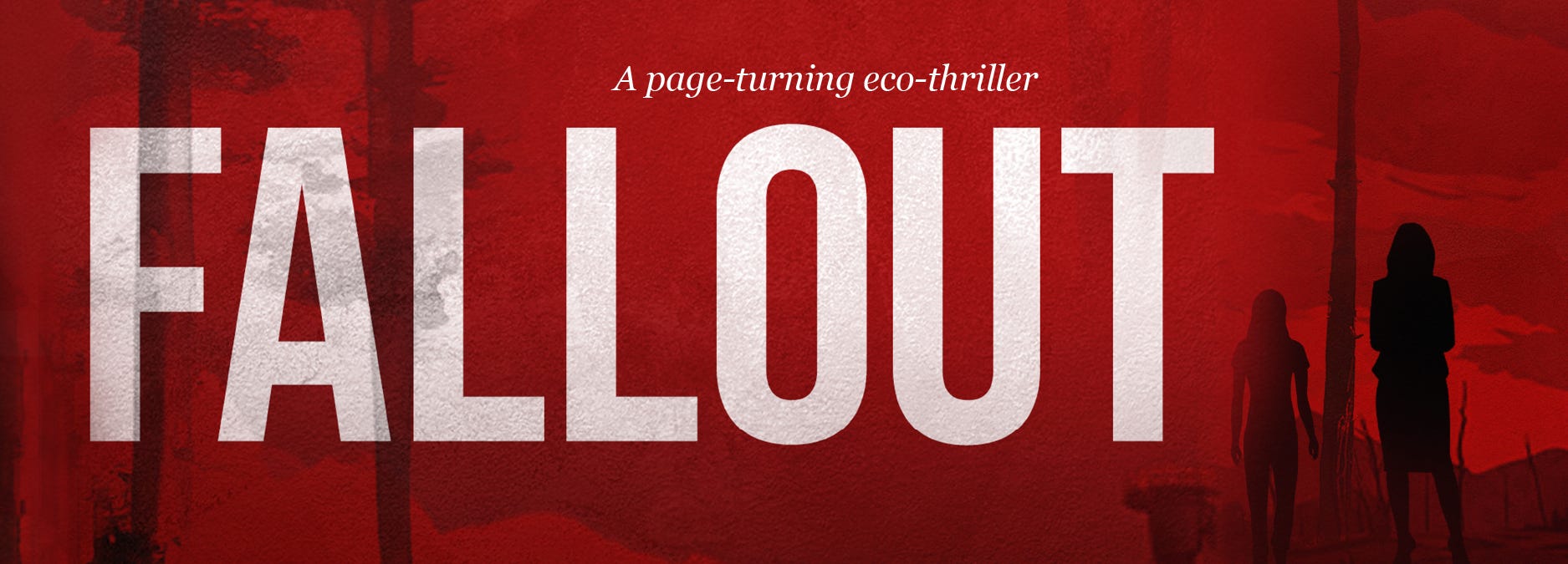
Come join me on the book tour path for Fallout…
Saturday, May 31, Jordan in conversation with author Nina Schuyler (author of In This Ravishing World): Book Passage, Corte Madera, CA. 1-2:30 p.m. PT.
Sun June 1. Bay Area Book Festival, signing at the Sibylline Books Booth
Thursday, June 12, 7pm PT. Jordan in conversation with Michael Keefe, author of All Her Loved Ones, Encoded. Annie Bloom’s Books, Portland, OR.
Saturday June 21. In conversation with Gayle Brandeis, author of Drawing Breath and Many Restless Concerns, Secret World Books, Highland Park (Chicago). 2pm ET
Weds, September 10, 6pm. Readers’ Books, Sonoma. “Writing at the Root.” In conversation with Rebecca Lawton, author of What I Never Told You).
Central Coast Writers Conference, September 26-28.
Stories, for me, provide the structure I can hang my choices on. I read Tarot, not for psychic input, but because, if the deck is vivid enough, I can create a story from the cards I pull. As I look at them, the story develops and I can understand how to structure my choices so I can move forward. I know it sounds weird, but it works for me.
I appreciated this piece as I, too, started my writing career early. As a child I would use crayons to write my stories in scribbles on whatever was handy, including the walls in the kitchen, dining room, and bathroom!